PFAS, or per- and polyfluoroalkyl substances, is a category of human-made chemicals that have been widely used in a variety of products and industries, such as firefighting foams, protective coatings, and surfactant applications among
many other uses and products. This website section provides information on PFAS particularly oriented toward private wells and the water well industry to help you understand the sources and occurrence of PFAS in groundwater. If you are concerned
about the possibility of PFAS in your drinking water and are served by a private well, both NGWA and the U.S. Environmental Protection Agency recommend testing your drinking water as well as reaching out to your local health department for information.
As an authority on groundwater in the United States, NGWA is a leader in the science of PFAS affecting this important natural resource. Directed by a standing task group dedicated to advancing the knowledge of this emerging topic, NGWA’s PFAS initiatives
include hosting PFAS conferences focused on groundwater and publishing multiple products (technical guidance documents, white papers, fact sheets, position papers) related to PFAS, groundwater, and the water well industry.
The last several years have seen a flurry of wide-ranging legislation concerning PFAS (per- and polyfluoroalkyl substances) from Capitol Hill and state legislatures. NGWA has been a key resource on not only providing the sound science to inform policymakers
about these “forever chemicals,” but also providing solutions that our members’ expertise can provide to ensure our groundwater resources are safe and reliable. While we agree states have a right to manage and regulate PFAS based
on their unique circumstances, we also feel the federal government must provide clearer and scientifically researched guidance on PFAS treatment and disposal.
NGWA continues to advocate for:
- Supporting a bipartisan solution that creates a maximum contaminant level — or MCL — for PFOA (perfluorooctanoic acid) and PFOS (perfluorooctanesulfonic acid) based on the best available science
- Dedicating financial and technical resources to private well owners for testing and remediating PFAS
- Properly funding PFAS programs and solutions to ensure our groundwater is safe and reliable
- Advanced guidance from the EPA on the treatment and disposal of PFAS.
PFAS: Top 10 Facts
Download PFAS: Top 10 Facts.
PFAS:
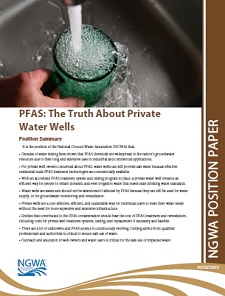
The Truth About Water Wells position paper
NGWA published this position paper in 2022 that provides facts about PFAS and how water wells can still provide safe water because effective residential-scale PFAS treatment technologies are commercially available. It is ideal for sharing with local,
state, and federal officials. Download the position paper.
Practical Guide for PFAS Sampling white paper

The NGWA white paper, Practical Guide for PFAS Sampling, provides a practical guide to PFAS sample collection for those familiar with industry-standard environmental
field sampling practices.
Groundwater professionals may be called on to sample for PFAS analysis and to interpret PFAS laboratory data. The presence of PFAS in many products, potentially including products commonly used in environmental field sampling efforts, should be considered
when planning a PFAS sampling program, and this document provides a guide for such programs.
PFAS Fate and Transport 2021 white paper
NGWA’s white paper, PFAS Fate and Transport 2021, updates section four of the NGWA guidance document, Groundwater and PFAS: State of Knowledge and Practice,
which was published in 2017.
Since the release of that guidance document, many studies have investigated PFAS (per- and polyfluoroalkyl substances) transformation, partitioning, and transport; for example, the influence of PFAS accumulation at media interfaces, such as the air-water-solid
interfaces in the vadose zone.
This white paper picks up where that section of the guidance document left off by providing important updates.
PFAS
risk communication
As a groundwater professional, you may need to inform a customer of the potential for PFAS contamination in their well water and subsequent actions to mitigate exposure. PFAS Risk Communication for Contractors is a two-page fact sheet to aid groundwater professionals in such communications. The document features common questions that may be asked and talking points that may be of assistance. 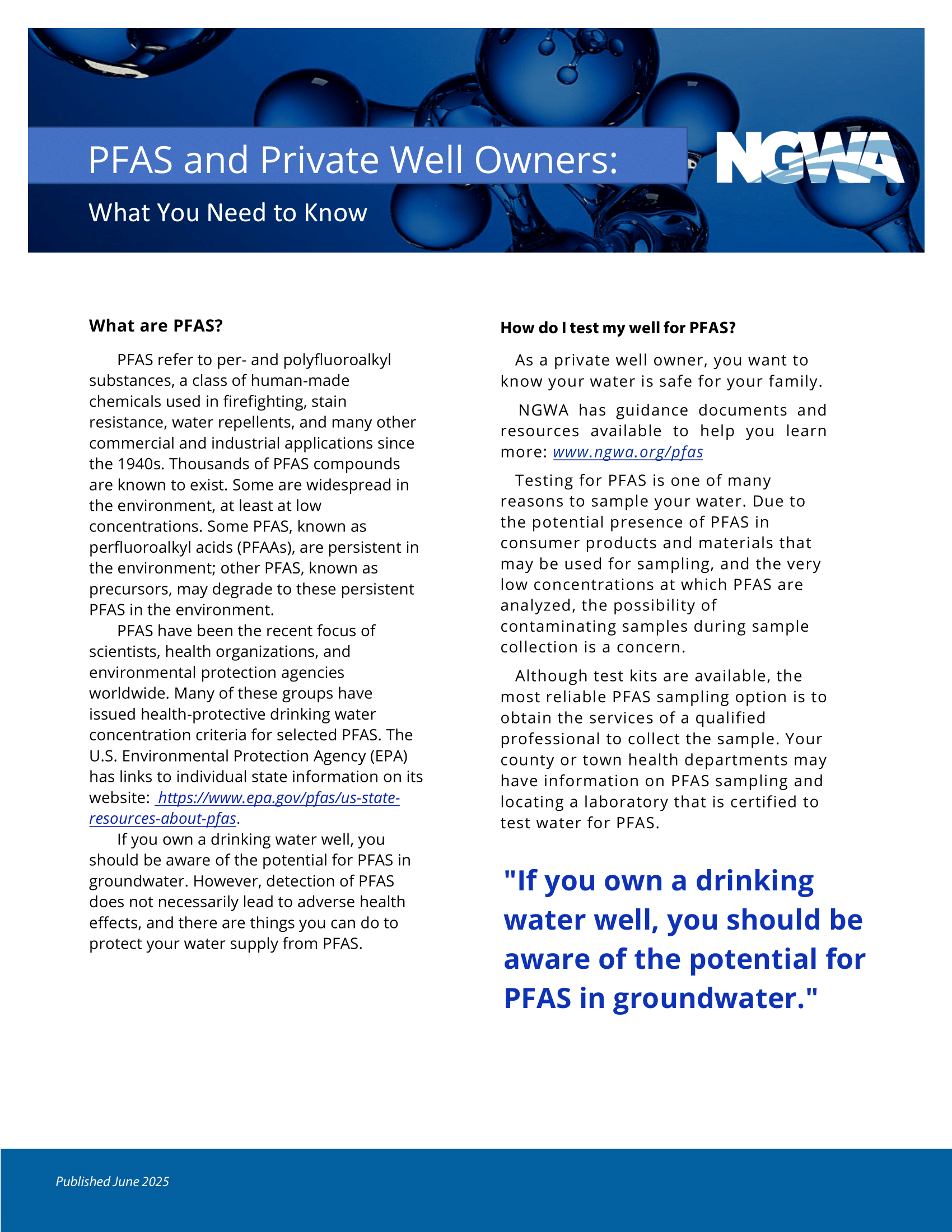
PFAS and private well owners
PFAS and Private Well Owners: What You Need to Know is a two-page fact sheet that groundwater professionals can distribute to customers and others in their community concerned about PFAS. Written in easy-to-understand language by groundwater professionals, it explains what PFAS are, how to test wells for
PFAS, treatment options, and more.
NGWA guidance document
NGWA published Groundwater and PFAS: State of Knowledge and Practice, a guidance document on PFAS in 2017. 1a8c856a29444822994ed2f71bbb8296673acaad-7cfb-4d44-94a3-163a0d2fd453.png?sfvrsn=4576d673_1)
Created by 36 NGWA volunteers who spent 1100 hours on it over the
course of 12 months, it is a comprehensive eight-part piece exploring the potentially hazardous, and widely discussed, compounds in groundwater and soil. NGWA published the document to identify the known science and knowledge related to PFAS; it summarizes
the fate, transport, remediation, and treatment of PFAS, as well as current technologies, methods, and field procedures.
Water and soil guidelines and regulations
Click here to be redirected to a website where the Interstate Technology and Regulatory Council (ITRC) maintains fact sheets on PFAS along with Excel® spreadsheets that contain
PFAS water and soil regulatory and guidance values by state and federal agencies.